Embark on an unforgettable eight-day overland journey along the legendary Karakoram Highway to the breathtaking Hunza and Gojal Valleys, with comfortable hotel stays throughout the tour.
Travel through the dramatic Indus River gorges, known locally as the Lion River, and witness the rare confluence of the world’s highest mountain ranges: the Karakoram, Himalayas, and Hindu Kush. Often described as the Eighth Wonder of the World, the Karakoram Highway offers some of the most spectacular mountain scenery on Earth.
Spend several days exploring Hunza Valley, a region famous for its peaceful Ismaili Muslim culture, warm hospitality, and the remarkable longevity of its people. Enjoy scenic day walks and short treks to glaciers descending from towering snow-capped peaks, offering close encounters with raw mountain wilderness and unforgettable alpine landscapes.
This tour is ideal for travelers seeking soft adventure, cultural discovery, and iconic mountain journeys in northern Pakistan.
Arrive in Islamabad, Pakistan’s capital city. After meeting the Rock Valley Tours team at the airport, we drive to Taxila, the ancient capital of the Gandhara Buddhist civilization and one of South Asia’s most important archaeological sites.
Visit:
Sirkap (ancient city ruins)
Julian Monastery
Taxila Museum, showcasing artifacts including coins from the era of Alexander the Great (326 BC)
After lunch, we continue toward Naran or Besham via the scenic valleys of Mansehra District, joining the legendary Karakoram Highway (KKH), a historic joint project between Pakistan and China.
Dinner and overnight stay at the hotel.
(Drive: 4–5 hours | Distance: approx. 200 km)
Early morning departure for Gilgit, the capital of Gilgit-Baltistan. At Thakot, we cross a Chinese-built bridge and enter the dramatic Indus River Gorge, once a vital branch of the ancient Silk Route.
En route highlights:
Rock carvings at Shatial
Lunch stop at Chilas
Thalichi viewpoint, offering spectacular views of Nanga Parbat (8,125 m), also known as the “Killer Mountain.”
Views of Rakaposhi and the Haramosh Range
We pass the junction where the Karakoram, Himalaya, and Hindu Kush mountain ranges meet. The Gilgit River joins the Indus here.
Dinner and overnight stay in Gilgit.
(Drive: 6–7 hours | Distance: approx. 320 km)
After breakfast, cross a suspension bridge to Kargah Valley to visit the 7th-century Buddha carving, a reminder of the region’s Buddhist heritage.
Continue along the Hunza River following sections of the original Silk Route. Stop at the Rakaposhi Viewpoint before reaching Karimabad, the cultural heart of Hunza Valley.
Dinner and overnight stay at the hotel in Karimabad.
(Drive: 2–3 hours | Distance: approx. 110 km)
A relaxed day to explore Hunza Valley at your own pace.
Activities include:
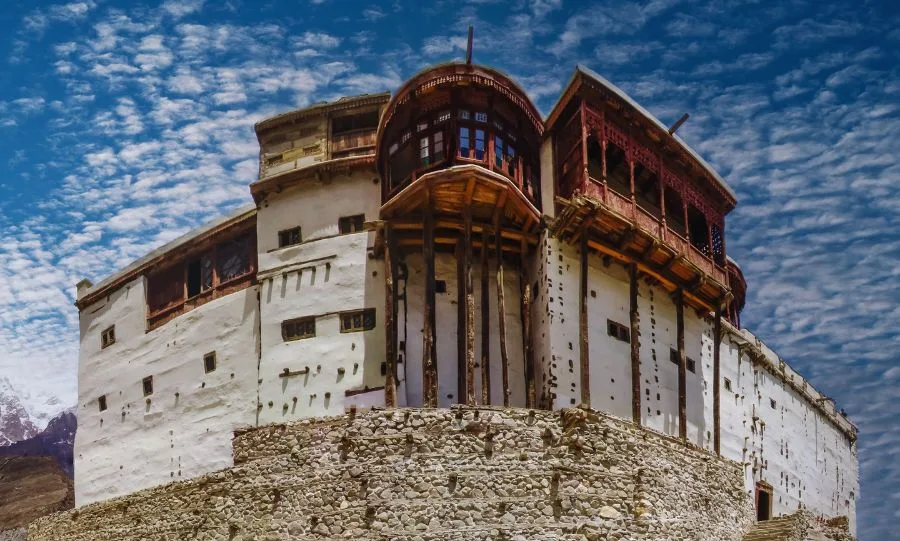
Walking tours to Baltit Fort and Altit Fort
Exploring Karimabad Bazaar
Scenic views of Rakaposhi, Diran Peak, Ultar Peak, Golden Peak, and Nagar Valley
Optional afternoon walk to Ultar Glacier or a leisurely village stroll along traditional irrigation channels.
Dinner and overnight stay in Karimabad.
Drive deeper into the Karakoram Mountains toward Upper Hunza (Gojal Valley).
Stops include:
Gulmit Village: visit traditional houses, fields, and the polo ground
Short trek to Gulkin Glacier and Borit Lake
Continue to Passu, a picturesque village set beneath the dramatic Passu Cones, with nearby Passu and Batura Glaciers.
Dinner and overnight stay at the lodge in Passu.
(Drive: approx. 1 hour | Distance: 50 km)
Morning walk to Passu Glacier and Passu Lake (approx. 45 minutes one way), offering close-up views of Shispar Peak (7,611 m) and Passu Peak (7,478 m).
After lunch, visit the famous Hussaini Suspension Bridges, still used daily by local communities.
Dinner and overnight stay at the lodge in Passu.
Drive back along the Karakoram Highway, following the Hunza River and enjoying final views of the Karakoram range.
Dinner and overnight stay in Naran or Besham.
(Drive: 6–7 hours | Distance: approx. 260 km)
Early departure for Islamabad via Abbottabad, with a lunch stop en route. Upon arrival, transfer to Islamabad International Airport for onward flight.
End of services.
(Drive: 8–10 hours | Distance: approx. 500 km)
Do not hesitage to give us a call. We are an expert team and we are happy to talk to you.
+92 347 4598096
info@rockvalleytours.com
Do not hesitage to give us a call. We are an expert team and we are happy to talk to you.
+92 347 4598096
info@rockvalleytours.com
If you’re traveling to Pakistan, you’ll need a visa. Depending on your nationality, you can get it on arrival or apply online before your trip. You can also go to your local Pakistani embassy for a tourist visa. The length of stay varies: e-visas can be up to 3 months (extendable to 6 months), while visas on arrival are valid for 30 days. Make sure to check visa requirements with the authorities, as they might change.
In Pakistan, what you wear depends on when and where you’re going. In hot areas, wear light, loose clothes like a shirt and trousers. For cold places, bring warm clothes like a jacket and layers. When visiting mosques, cover your head, arms, legs, and shoulders. Dress modestly and avoid shorts. If you’re unsure, it’s best to dress conservatively.
June–September: Monsoon season with unpredictable rains, reaching over 45°C (113°F) in June. Floods can occur.
October/November: Post-monsoon season with decreasing temperatures and rainfall. Days are warm, nights cool.
December–February: Winter months with pleasant daytime temperatures around 20°C (68°F) and colder nights, especially in the northern mountains where it snows.
March–May: Hot and dry season with temperatures in the mid-30s°C (95°F) in low-lying areas, getting hotter towards the north.
Although Pakistan has faced challenges in recent years, it’s now generally safe to visit as long as you stay in busy areas. Some people might worry about coming here, but trust us, there’s a lot to discover beyond what you see in the news. You can be confident that Rock Valley Tours wouldn’t take you anywhere unsafe.


